               |
2737 Private Albert Barrow & 2738 Private Thomas Gill MM
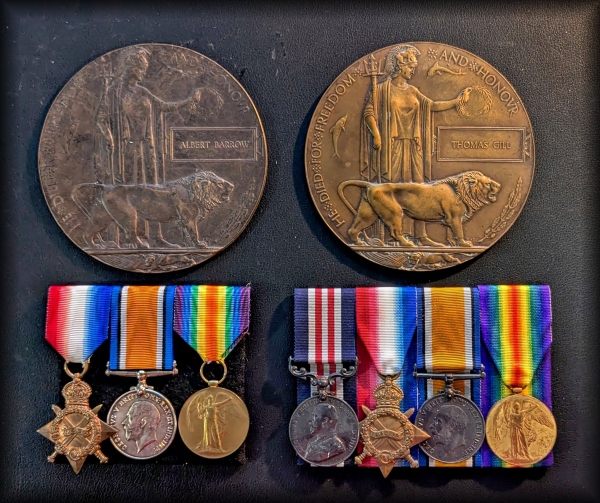
Albert Barrow and Tom Gill were two boys from Newburgh, best friends who went to school together, grew up together, joined the Army together to serve in the Great War, and both died serving their country
Albert Barrow was born in Newburgh on 20th March, 1888, the son of John (1847-1913) and Ruth Barrow nee Dean (1850-1914). His mother was born at Everton, and his father, born at Newburgh, was a labourer on the canal.
At the time of the 1891 Census, the family were living at Back Lane, Newburgh. His father was away, and his siblings are recorded as Elizabeth E, 16yrs, born at Everton; Ruth Alice, 10yrs, born Newburgh; John, 7yrs, born at Newburgh; Thomas, 5yrs, born at Newburgh and Albert aged 3yrs.
Thomas Gill was also 3yrs old, and his family, too lived in Back Lane. His father was William Gill, 38yrs, a Canal Boatman, born at Liverpool and his mother was Hannah, 33yrs, born at Pendleton. Thomas’ siblings were Mary, 5yrs, born Lathom; William 1yr, born Newburgh. Thomas was born at Lathom according to this Census.
Albert and Thomas (Tom) were the same age, lived in the same street in a small village, and both their fathers worked on the nearby Leeds-Liverpool Canal. They would have been classmates at the village school.
At the next Census, in 1901, Albert’s father was still employed as a canal labourer, now 53yrs old. But the family address is now recorded as ‘Newburgh Village’. Perhaps they had moved onto the main road through the village, close to the Red Lion public house. At home were, Albert, 13yrs, Albert’s mother Ruth, 50yrs, siblings John, 17yrs, like his father, a canal labourer; Thomas, 15yrs, an agricultural labourer; and Ruth A, 20yrs.
Tom’s family were still at Back Lane – Tom’s father, William, 46yrs, Canal Boatman, Tom’s mother Hannah, 42yrs, and siblings William, 11yrs, Maggie, 7yrs, John, 5yrs, Eleanor, 1yr, and Hannah, 1 month old. All the younger siblings were born at Newburgh.
By 1911, the Barrow household consisted of John & Ruth, now 64 and 60 yrs old respectively, with John now working as a ‘Bank Ranger’ employed by the Leeds & Liverpool Canal Company. Also at home are daughter, Ruth Alice, 30yrs, single, and Albert, 23yrs, single and employed as a boat builder. The Census record also tells us that John and Ruth have been married for 39 years, and, of their 10 children, six had died.
William (55yrs) and Hannah Gill (51yrs) have been more fortunate. They had been married for 26 years, had had seven children, only one of whom had died by this time. At home for the Census, apart from William and Hannah, were Tom, 23yrs, working in a stone quarry, Mary, 25yrs, Margaret, 17yrs, John, 15yrs, Eleanor, 11yrs and Hannah, 10yrs.
When war broke out in August 1914, it probably seemed quite remote to the people of Newburgh, but the call for men to enlist quickly spread throughout the country. Ormskirk’s Drill Hall, later to be known as the Civic Hall, was the base for the Ormskirk Company of the 9th Battalion of the King’s Liverpool Regiment, which had its headquarters at Everton Road, Liverpool. The Drill Hall became one of the recruiting offices in the town, and many local men signed up there. Albert was, at this time, employed on the docks in Liverpool, so this was probably the reason he and Tom attested in Liverpool, probably at Everton Road, on Monday, 19th October 1914. The 9th King’s had been deployed at the beginning of the war, initially to Dunfermline Scotland as part of the Firth of Forth defence scheme, at a time when there was a perceived threat of a German invasion, but by the time Tom and Albert joined them, they were in Tunbridge Wells which was to be there home until the battalion proceeded overseas the following March. Apart from the standard training, the battalion, or parts of it, were used for guard duties and for the preparation of defences in case of invasion. On 12th March 1915, the two friends, with their battalion, were on their way to France. More training and a gradual introduction to war on the Western Front followed, and both men saw the war in all it’s raw brutality, spending time in the front lines, and regularly losing comrades.
Wigan Examiner, 17th July 1915: It was in the trenches at Vermelles, in northern France that Albert Barrow received a gunshot wound to his head on 29th July 1915. He was evacuated to No. 1 Field Ambulance where he died the following day. Original reports said that he had been buried 'Behind the firing line' but it was later confirmed that he had been buried in the Bethune town cemetery. The Battalion War Diary states simply: "3 other ranks wounded; 1 other rank died of wounds." The Army Records Office at Preston, wrote to Miss Ruth A. Barrow at "Newburgh Village, Wigan, Lancashire" on 29th April 1916 asking her to acknowledge receipt of "1 Cigarette Case, 1 Belt". His parents were both deceased before he enlisted. At some time after Albert's death, his brother, Thomas, lived at 62, Delph Street, Wigan.
Wigan Examiner, 7th August 1915:
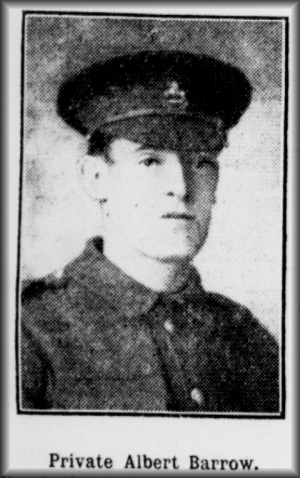 Ormskirk And The War – War’s First Newburgh Victim – Newburgh Man Killed News has been received at Newburgh that Pte. Albert Barrow has died as a result of wounds received in action “somewhere in France”. He was shot in the head on Thursday, 29th July and died shortly after midnight on 30th July. He was 29 years of age and was a boat builder by trade, following his employment at the dockyard at Parbold, and just prior to joining the Army in October last, at Liverpool. He was a most popular man both in Newburgh and Parbold, and was a member of the Parbold Old Prize Band. That he was popular amongst his soldier comrades is testified by several letters of sympathy from various members of the 9th, amongst which was one from Pte. Tom Gill, who deplores the loss of his greatest friend; he and Pte Barrow enlisted together. The deceased soldier was buried behind the firing line. On Sunday, at the Newburgh Parish Church, the vicar, the Rev. C. Harris, made a touching reference to his death during the morning sermon, when he said: - “The man who dies a soldier’s death today has made the supreme sacrifice, and set the noblest example that was in his power. One is now especially in our thoughts – the first of our Newburgh men to fall in action. Pte. Albert Barrow, of the 9th King’s Liverpool Regiment, will be remembered with affection not only here in his own home and parish, but by those with whom he fought, side by side, and to whom, by his character, he has endeared himself so greatly. Always cheerful, courageous even to the point of daring, always hopeful ever ready to cheer and hearten and help a friend – no wonder that he was popular among his fellows, and that he lived so as to be greatly missed.”
A LAST LETTER
MEMORIAL SERVICE
Wigan Examiner, 14th August 1915:
Wigan Examiner, 11th September 1915: Thomas Gill wasn’t there when Albert was mortally wounded. He was in hospital suffering from rheumatism, which particularly affected his legs. On his return to the battalion, having been declared fit, he received the devastating news – the loss of his best friend. Tom was wounded at the Battle of Loos, in September, but returned to duty again and survived the Battle of the Somme in 1916. He was an experienced soldier by 1917 and the Third Battle of Ypres – best know as ‘Passchaendale’. After heavy losses on the first day of the battle, 31st July 1917, Tom and the 1/9th King’s were back in action on the 20th September. He was one of a small group of men sent out into the dangers of No Man’s Land before his battalion attacked, to reconnoitre the ground which they would attack over. For his valuable work in this period, he was awarded the Military Medal for gallantry.
Ormskirk Advertiser, 22nd November 1917 & Wigan Examiner, 24th November 1917:
Liverpool Daily Post 24th November 1917: Tom had been serving for over four years on the Western Front by the summer of 1918 and at the end of August, his luck finally ran out. He was badly wounded and evacuated to a military hospital at Rouen, where he died of his wounds on 1st September.
Liverpool Echo, 5th September 1918: In 1921, Hannah Gill, Tom’s mother, was granted a dependant’s pension as a result of Tom’s death in service. Her address at that time was Deans Lane, Newburgh. Both commemorated on the Newburgh village war memorial

|